
Construction Site Cameras vs CCTV: Why Security Cameras and Progress Cameras Do Different Jobs
Not every camera on a construction site is installed for the same reason.
Some cameras are there to help protect the site.
Some cameras are there to document the project.
Some cameras help a site team check what is happening remotely.
And on many construction projects, you may need more than one type of camera doing more than one job.
That is the way I look at the difference between CCTV and construction progress cameras.
I do not see it as CCTV being wrong and time-lapse being right. That would be too simple, and it would not be true.
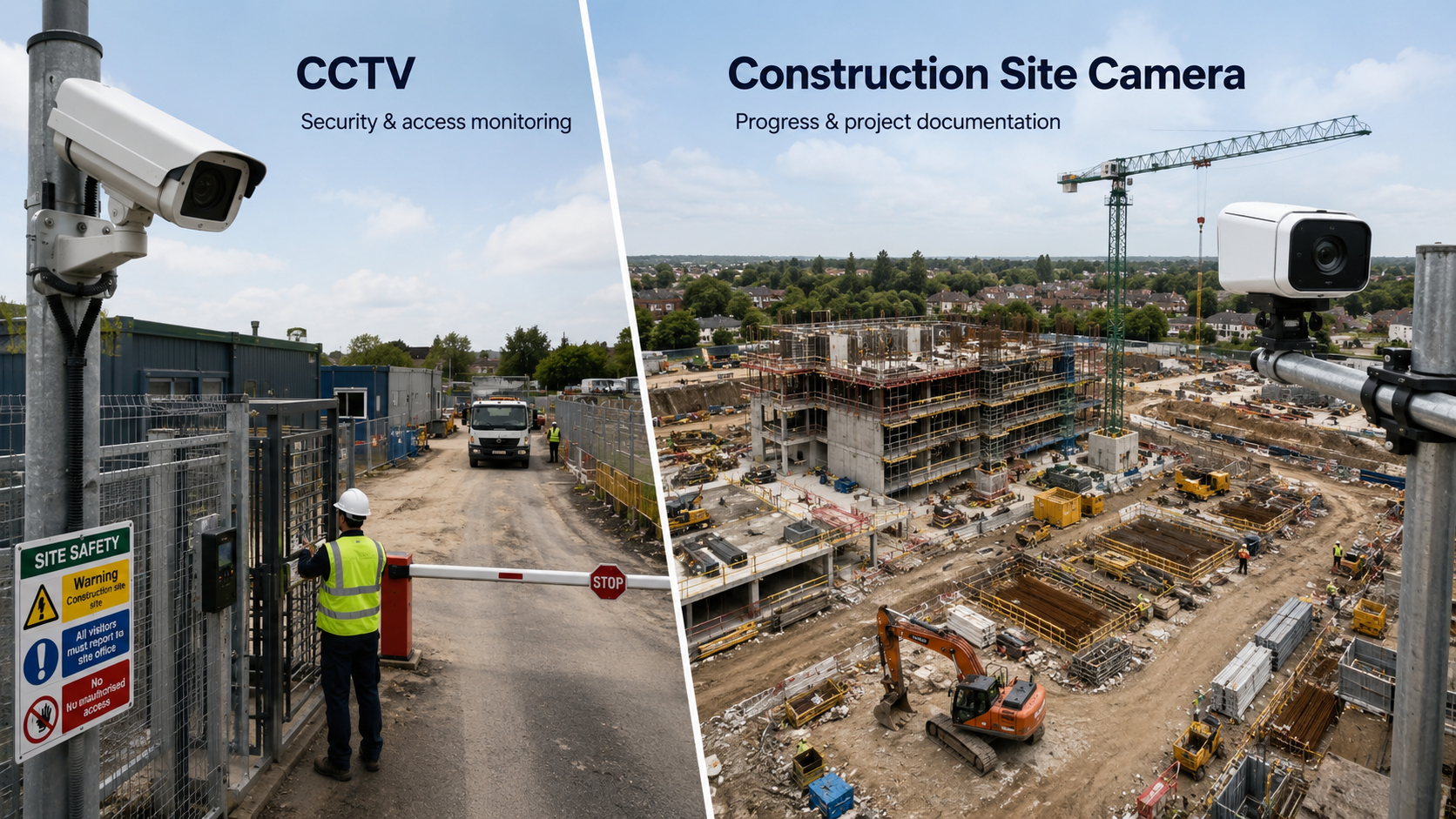
CCTV has a very clear role on construction sites. It is there for security, access monitoring, deterrence and reviewing footage if something happens.
A construction time-lapse or progress camera has a different role. It is there to document the work, show progress over time and create a visual record of the project.
The simplest way I can explain it is this:
CCTV helps protect the site.
Time-lapse helps protect the story of the project.
That distinction matters.
Because a site can have CCTV and still not be properly documented.
CCTV and construction progress cameras are not the same thing
The confusion usually starts because both systems involve cameras.
When people talk about construction site cameras, they may be talking about different things. Some mean CCTV. Some mean progress cameras. Some mean time-lapse cameras. Some mean a system with live view or remote access.
That is why it helps to be clear about the purpose of the camera before comparing the options.
A CCTV camera is a camera.
A construction time-lapse camera is also a camera.
Both can be installed on a building site.
Both may offer some form of remote viewing.
Both may capture useful footage or images.
But that does not mean they are doing the same job.What CCTV is usually used for on a construction site
CCTV on a construction site is usually there to support security.
That might include:
Monitoring site entrances
Watching compounds or storage areas
Helping deter theft or trespassing
Reviewing incidents
Supporting out-of-hours monitoring
Keeping an eye on plant, machinery or materials
Recording activity in higher-risk parts of the site
For many projects, this is important.
Construction sites can have expensive equipment, open access points, changing layouts and valuable materials. A proper CCTV setup can help protect the site and give the team footage to review if something happens.
That is exactly where CCTV is strong.
It is not there to make the project look good.
It is not usually there to tell the story of the build.
It is there to help protect the site.
What a construction progress camera is usually used for
A construction progress camera, or construction time-lapse camera, is usually installed for a different reason.
It is there to capture the project as it develops.
Instead of recording continuous security footage, it usually captures high-quality images at set intervals. Those images build up over days, weeks, months or years and create a visual record of the project.
This can be used for:
Progress updates
Client communication
Stakeholder reporting
Internal project records
Marketing content
Final time-lapse videos
Project handover content
Tender and case study material
This is where construction progress monitoring becomes useful, especially when clients or stakeholders need regular visual updates without visiting site every week.
The value is not just in seeing what is happening right now.
The value is in being able to look back and show what happened over time.
That is where progress cameras are different from CCTV.
A CCTV system may help protect what is on site.
A progress camera helps preserve the work that went into the project.The camera angle tells you a lot
One of the easiest ways to understand the difference is to look at where the camera is positioned.
A CCTV camera is often positioned for security.
That might mean it is facing a gate, entrance, storage area, access route, compound or boundary.
That makes sense if the goal is to monitor movement, review activity or protect the site.
A progress camera is usually positioned differently.
It needs to show the project clearly as it changes over time. That might mean placing it higher up, further back or in a position where the structure, site activity and visible progress can be captured properly.
This is why I do not think every site camera should be judged in the same way.
The best angle for security is not always the best angle for progress.
A CCTV camera facing a gate may be perfect for monitoring access, but it may tell very little about how the project is actually developing.
A time-lapse camera overlooking the main build area may be excellent for project documentation, but it may not be the best tool for monitoring a compound at night.
Different purpose.
Different position.
Different result.
A site can be watched without being properly documented
This is one of the main points I think contractors and project teams should think about.
Having CCTV on site does not automatically mean the project is being documented properly.
CCTV may show that activity happened.
But it may not show the project in a way that is useful for progress updates, stakeholder communication or final project content.
The footage may be facing the wrong area.
The image may not be suitable for presentation.
The footage may be too long to use practically.
The camera may be installed for evidence, not storytelling.
That does not make CCTV bad. It just means it is doing a different job.
A site can be watched from a security point of view and still have no clear visual record of how the project came together.
That is the gap a construction progress camera fills.
CCTV protects the site
CCTV is usually the better tool when the main concern is site security.
If the priority is theft prevention, trespassing, vandalism, access control or out-of-hours monitoring, CCTV is normally the right starting point.
A proper CCTV setup can be planned around the areas that need protection.
This might include:
Entry and exit points
Site compounds
Storage areas
Perimeter fencing
Machinery and plant
Delivery areas
High-risk parts of the site
This kind of setup is valuable because it gives the site team visibility over the areas where security matters most.
If something happens, CCTV footage can help with review, reporting and evidence.
That is why I would not position a time-lapse camera as a replacement for proper CCTV.
If security is the issue, you need a security-led solution.
Time-lapse protects the story of the project
A time-lapse camera has a different value.
It protects the story of the project by capturing the work as it happens.
Construction projects change quickly. Groundworks are completed. Steel goes up. Roofs go on. Facades close. Fit-outs move forward. External works change the entire look of a site.
Once those stages have passed, they cannot be captured again.
That is why progress documentation needs to be planned early.
If a project is important, long-term, public-facing or stakeholder-heavy, there is real value in having a clear visual record from the start.
Not just for marketing.
For communication.
For stakeholders.
For the project record.
For showing the value of the work when it is complete.
That is where construction time-lapse cameras are useful.
They do not just show the finished building.
They show how the project got there.
Live view does not automatically mean CCTV
Another area where the lines can blur is live view.
Some people hear “live view” and immediately think CCTV.
But live view is not exclusive to CCTV.
Many modern construction progress cameras can also offer remote access or live viewing. That means a client, project team or stakeholder may be able to check in on the site without physically being there.
The difference is the purpose behind the camera.
With CCTV, live view is usually part of a security setup.
With a construction progress camera, live view can be useful, but it is not the whole value.
The bigger value is the image archive being created in the background.
That archive can be used for progress updates, final time-lapse videos, internal reporting and project documentation.
So the question is not simply:
“Can I see the site live?”
The better question is:
“What do I need this camera to produce over the life of the project?”
The cameras used for progress are not usually traditional CCTV cameras
When I talk about construction site cameras in this context, I am not talking about standard CCTV cameras.
I am talking about progress cameras designed to capture high-quality images at set intervals, with the option of remote access or live view depending on the project.
The type of camera we use for long-term construction projects is designed around scheduled image capture rather than continuous CCTV recording.
That means it can capture images consistently throughout the project and build a visual archive over time.
Some modern construction camera platforms may also include features such as:
Remote access
Live view
Cloud-based project visibility
AI tools
Image filtering
Visual analytics
Privacy options such as face blurring
Those features can be useful, but they should support the purpose of the camera rather than distract from it.
For me, the main question is still simple:
Is the camera there mainly to protect the site, or is it there to document the project?
That question usually makes the decision much clearer.
Which camera setup does your construction site actually need?
Where CCTV is the better choice
CCTV is usually the better choice if the main priority is security.
Choose CCTV if:
- Security is the main priority
- You need to deter theft or trespassing
- You need out-of-hours monitoring
- You need continuous video recording
- You need to review incidents
- You need to monitor access points or compounds
- You are protecting plant, materials or equipment
In that situation, a proper CCTV or monitored security setup is usually the right place to start.
A construction progress camera may support visibility, but it should not be treated as a full security system unless it has been designed for that purpose.
Where a construction time-lapse camera is the better choice
A construction time-lapse camera is usually the better choice when the main priority is progress visibility and documentation.
Choose a construction time-lapse camera if:
- You want to document progress
- You need regular visual updates
- You want to keep clients or stakeholders informed
- You want a final time-lapse video
- You want high-quality images of the project
- You want content for marketing, PR or social media
- You want a visual archive of the build
- You want to reduce unnecessary site visits
- You want remote visibility without relying only on traditional CCTV
- You want a camera setup designed around long-term project documentation
This is where time-lapse becomes more than a final video.
It becomes part of how the project is communicated during the build.
When using both makes sense
For many serious construction projects, the strongest answer is not one or the other.
It is both.
Use both if:
- The site needs security and progress documentation
- The project is long-term
- There are multiple stakeholders involved
- The client wants visibility
- The contractor wants a record of the build
- The site has valuable materials or equipment
- The finished project will be useful for marketing, tenders or case studies
This is common on larger projects.
The CCTV system protects the site.
The time-lapse camera protects the story of the project.
They are not competing with each other.
They are solving different problems.
A practical example
Let’s say a contractor is building a new commercial unit, residential development or pharmaceutical facility.
The CCTV system might be positioned around the entrance, boundary, storage areas and compound. Its job is to protect the site and help review activity if something happens.
The time-lapse camera might be positioned higher up, looking across the main build area. Its job is to capture the development of the project over time.
The CCTV footage may only be used if there is an issue.
The time-lapse images may be used throughout the project for updates, shared internally, included in reports, used on LinkedIn and eventually turned into a final project video.
Both cameras are useful.
But they are useful in different ways.
This was the case when we documented the build of a large GMP pharmaceutical packaging facility in Stamullen for PCI Pharma Services. The site had its own security requirements, while our role was to capture the progress and story of the build over time.
That is usually the cleanest way to think about it.
Security and documentation are not the same job.
GDPR and privacy should be considered for both
Any camera on a construction site needs to be thought through properly.
If people can be identified in footage or images, privacy and data protection need to be considered.
That applies to CCTV.
It also applies to construction progress cameras.
For sites in Ireland, the purpose of the camera should be clear. The site should also think about signage, access, retention, positioning and whether the camera use is fair and proportionate.
There is also a difference between documenting a project and monitoring workers.
That line matters.
If the camera is installed to capture progress, it should be used for that purpose. If it is installed for security, that should be clear too.
Before putting any camera on site, it is worth asking:
Why is this camera being installed?
What is it capturing?
Who will have access?
How long will images or footage be stored?
Is there clear signage?
Are workers and relevant parties aware?
Is the camera positioned in a way that is fair and proportionate?
Are privacy features such as face blurring needed?
The point is not to capture everything for the sake of it.
The point is to capture the right things, for the right reason, in the right way.
The main difference comes back to purpose
The easiest way to decide between CCTV and a construction progress camera is to start with the purpose.
Do not start with the camera.
Start with what you need the camera to do.
If the main issue is security, CCTV is usually the right place to start.
If the main issue is project visibility, stakeholder updates and long-term documentation, a construction time-lapse camera is usually the better tool.
If the project is large, long-term, high-value or has multiple stakeholders, both may make sense.
For me, the difference is simple:
CCTV protects the site.
Time-lapse protects the story of the project.
Final thoughts
CCTV and construction time-lapse cameras are not the same thing. They can both sit on the same site, but they are usually there for different reasons. CCTV is mainly there to help protect the site, monitor access and support security. A construction progress camera is there to document the site, show progress and create a visual record of the build.
There is overlap, especially when modern construction cameras offer live view or remote access. But the purpose is still different. A site can be watched without being properly documented. And a project can be documented without pretending that a progress camera replaces proper security. That is why I think the best approach is to be clear from the start.
What needs to be protected?
What needs to be documented?
Who needs to see it?
And what will the footage or images be used for afterwards?
Once you answer those questions, the right camera setup becomes much clearer.
If the project needs polished updates for clients, LinkedIn, websites or stakeholder communication, construction video production may be a better fit than relying on camera footage alone.
If you are comparing progress camera options specifically, I have also written a separate guide on construction site cameras vs time-lapse cameras for project progress reporting.
Document your construction project properly
If you are planning a long-term construction project and want to document the progress properly, Scaling Visual can help with construction time-lapse cameras, drone updates and progress videos across Ireland.
We help contractors, developers and project teams create a clear visual record of their projects, from early stages right through to completion.
Whether you need a final time-lapse video, monthly progress updates or a better way to show stakeholders what is happening on site, we can help you capture the project properly from the start.